Screening from Series Darkness and Humanity: The Complete Akira Kurosawa
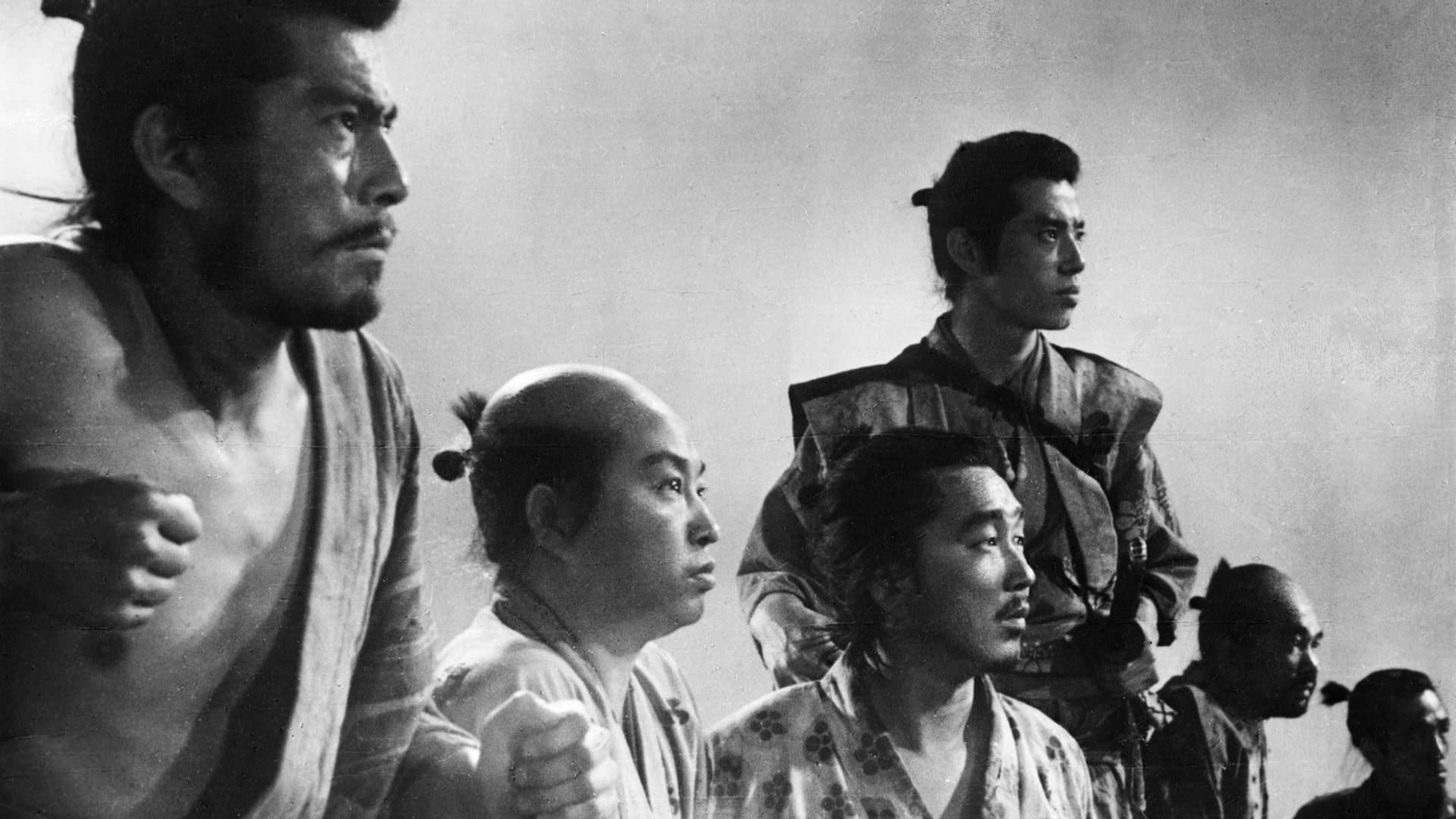
Seven Samurai (Shichinin no samura) in 35mm
Starts at $5
Sat, Mar 28, 2026
Know Before You Go
Plan your Visit
Theater Policies
Accessibility

Screenings
Rashomon in 35mm
Akira Kurosawa’s classic, time-shifting drama about a fatal encounter between a samurai, his wife, and a bandit in a desolate forest, and the accounts of four witnesses to the crime, revolutionized film language. Kurosawa’s narrative structure of exhibiting a single incident through subjective yet conflicting viewpoints introduced the “Rashomon effect” into popular culture. Rashomon received an Honorary Foreign Language Film Oscar from the Academy in 1951. With striking black-and-white cinematography by Kazuo Miyagawa and Oscar-nominated Art Direction (black-and-white), Rashomon remains one of global cinema’s most influential films.
35mm

Screenings
Ikiru (To Live) in 35mm
Akira Kurosawa explores embracing life through death in aging bureaucrat Kanji Watanabe (Takashi Shimura), who spends his days on autopilot at his monotonous desk job. When Kanji discovers that he has terminal stomach cancer, he questions the meaning of life, searching for a reason to continue living with the little time he has left. Shimura’s quietly expressive and heartbreaking portrayal of Watanabe is widely considered a career-defining role for the actor. The film received the Special Prize of the Senate of Berlin at the 1954 Berlin International Film Festival.
35mm

Screenings
Throne of Blood (Kumonosu-Jo) in 35mm
An adaptation of Shakespeare’s Macbeth, this jidai-geki, or period drama, set in feudal Japan, is part of a loose trilogy with The Lower Depths (1957, screening Sunday, April 19) and The Hidden Fortress (1958, screening Thursday, April 23). Shakespeare’s plays were translated for Japanese readers as early as 1868, though they were banned during World War II for not being original Japanese works; Kurosawa wanted to take on the challenge of adapting a British story to a Japanese sensibility. With staging based in traditional Noh drama and visual design inspired by Musha-e warrior paintings, Kurosawa created what he considered one of his most experimental works.
35mm

Screenings
Sanshiro Sugata with Sanshiro Sugata Part II
Sanshiro Sugata in 35mm
Kurosawa’s directorial debut, adapted by the filmmaker from a book by Tsuneo Tomita, deftly sets the stage for an unparalleled five-decade career. Set in 1882, Sanshiro Sugata follows an aspiring martial artist determined to prove his worth under an impressive sensei. Strong but undisciplined, Sugata gets into scraps that sow distrust and fear in his master and community. Tomita’s book established a story steeped in themes of honor and masculinity, and Kurosawa fleshed it out visually with organic, fluid camerawork; staging that emphasizes depth of field; and strong symbolism expressed through the power of nature and its untamable forces.
35mm / 35mm

Screenings
Drunken Angel (Yoidore Tenshi) in 35mm
“In this picture I finally discovered myself,” Kurosawa said in 1960 of his Occupation-period drama about a consumptive gangster (Toshiro Mifune, in a career-defining role) and the kind-hearted, alcoholic doctor (Takashi Shimura of Ikiru, 1952) who treats him. Set in war-ravaged Tokyo and using real locations to ground the story in authenticity, critics of the day noted a journalistic quality in the film, despite the director’s earlier The Most Beautiful (1944, screening on Saturday, Apr 11) also exhibiting topical themes. Widely considered one of his best from this period, Drunken Angel has been compared to Billy Wilder’s The Lost Weekend (1945), as both interrogate the consequences of decisions clouded by excessive drink.
35mm

Screenings
No Regrets for Our Youth (Waga seishun ni kui nashi) in 35mm
Following the Allied occupation of Japan, and in order to avoid censorship, Kurosawa’s films began to reflect the newly embraced pro-democracy worldview sweeping the country. These restrictions on story and theme led to the creation of one of his few female protagonists, the complex yet relatable Yukie Yagihara, embodied by celebrated actress and frequent future Ozu collaborator Setsuko Hara (Late Spring, 1949). Beginning in the aftermath of the Mukden incident, which incited the Japanese invasion of Manchuria, and jumping forward through the 1930s, Yukie navigates love, livelihood, family ties, and her future in a film that the director later revealed is deeply nostalgic for his own years spent coming of age before World War II. No Regrets for Our Youth was released the same year as Those Who Make Tomorrow, the only feature-length film directed by Kurosawa considered to be lost.
35mm

Screenings
Stray Dog (Nora inu) in 35mm
Rookie detective Murakami (Toshiro Mifune) loses his pistol to a pickpocket in a crowded, sweltering streetcar during his first day on the job. To save face, and with the help of skilled detective Sato (Takashi Shimura), he goes undercover through Tokyo’s underground to capture the culprit before any crimes are committed. An early breakthrough in Kurosawa’s career, Stray Dog explores the desperation of postwar Japanese society. Isao Kimura’s portrayal of the disillusioned war veteran-turned-thief marked the actor’s first appearance in a Kurosawa film.
35mm

Screenings
The Most Beautiful (Ichiban utsukushiku) in 35mm
Kurosawa’s second feature film takes a documentary-like approach to the fictionalized story of young women working in a wartime optics factory. Featuring a cast of dozens and shot on location at the Nippon Kogaku factory, The Most Beautiful experiments with narrative and exhibits Kurosawa’s skill with depth-of-field cinematography within his creative use of mise-en-scène. Tinged with the visual language and conceit of a Soviet-era propaganda film and steeped in wartime patriotism—especially in scenes of group activities such as volleyball matches and band practice—this portrait of female camaraderie stands out among Kurosawa’s oeuvre for its distinct focus on women protagonists and for predating the social realist filmmaking that would emerge in postwar Japan.
35mm

Screenings
The Men Who Tread on the Tiger’s Tail (Tora no o o wo fumu otokotachi) in 35mm
Shot exclusively on the soundstages of Toho studios, Kurosawa’s fourth feature is based on a kabuki play that depicts a 12th-century tale of Yoshitsune, a renowned commander of the Minamoto clan, and six samurai subordinates who disguise themselves as monks to cross enemy territory. Banned in postwar Japan by the US occupation for depicting feudal loyalties, this historical drama was finally screened in Japan after the Treaty of San Francisco signaled the withdrawal of US forces in 1952. The story is cinematically aligned with rhythmic dialogues including chanting and singing executed by the incredibly talented ensemble.
35mm

Screenings
The Quiet Duel (Shizukanaru ketto) in 35mm
During an urgent medical operation, a young doctor, Kyoji Fujisaki, accidentally cuts himself and contracts syphilis, which puts constraints on his life and personal relationships, especially with his fiancée. Toshiro Mifune poignantly explores Fujisaki’s agony and self-imposed isolation while he battles conflicting emotions of morality and desire. Kurosawa enhances the film with shots and depth of field that are meticulously timed and framed, and he creates a claustrophobic atmosphere by setting the action almost exclusively within the shabby confines of Fujisaki’s hospital.
35mm

Screenings
Scandal (Skyandaru) in 35mm
Released the same year as his celebrated Rashomon, Kurosawa’s tenth directorial effort was made in response to the rise of sensational tabloid journalism that paralleled Japan’s newfound concerns with freedom of speech. By crafting a story that follows two famous artists who sue a gossip rag for insinuating their romantic involvement, Kurosawa hoped that Scandal would spark such public outcry to the distasteful trend as to quash its popularity. As he noted in his 1982 memoir—and as evidenced with the later rise of reality television—“Scandal proved to be as ineffectual a weapon against slander as a praying mantis against a hatchet.”
35mm

Screenings
The Idiot (Hakuchi) in 35mm
Based on the 1869 novel by acclaimed Russian novelist Fyodor Dostoevsky, Kurosawa updates the setting from Saint Petersburg to Hokkaido for a story about “the destruction of a pure soul by a faithless world.” Facing an original runtime of more than four hours, the studio Shochiku forced him to cut it down to less than three, despite the director’s protests: “If you want to cut it, you had better cut it lengthwise.” Shochiku won the battle; Kurosawa left the studio. While the film was panned on its release in both Japan and America, the director told Donald Richie in 1990, “One should be brave enough to risk this kind of ‘mistake.’ Nowadays no one does.”
35mm

Screenings
I Live in Fear (Ikimono no kiroku) in 35mm
Kurosawa contemplates the horrors of the atomic bomb and the fear that permeated postwar Japan in this 1955 drama. Kiichi (Toshiro Mifune), an aging industrialist who owns a foundry, slowly loses his grip on reality as his fear of nuclear annihilation leads him to work toward relocating his family to Brazil. Alarmed by his paranoias, the family attempts to have him declared legally incompetent. I Live in Fear is a bleak, cautionary tale that explores dissonance of reality and delusion, driven by collective anxiety and instigated by isolation.
35mm

Screenings
One Wonderful Sunday (Subarashiki nichiyobi) in 35mm
Engaged couple Yuzo and Masako take a weekend trip to Tokyo, a city recently devastated by World War II, with little more than 35 yen—approximately $1—and the goal of having a great time. Employing sequences of fantasy via the couple’s imagination, One Wonderful Sunday is the most hopeful film from Akira Kurosawa’s early period. His fascination with dream life, seen in his later Dreams (1990, screening May 29), first emerges in this poignant, romantic, and hopeful vision of the future, which was shot entirely on location using hidden cameras with two unknown actors. The film earned Kurosawa a prize for directing at the Mainichi Film Awards, which he would later also receive for Kagemusha (1980) and Ran (1985).
35mm

Screenings
The Lower Depths (Donzoko) in 35mm
Kurosawa takes a picaresque approach in his adaptation of Maxim Gorky’s play of the same name from 1902, with a twist of humor and joy in underlying despair—the premise of the work. Set in the late Edo period, the film surveys the lives of a married couple and their tenants who are barely scraping by in a run-down tenement. Kurosawa uses the limited space of the tenement to create an intimate atmosphere for the ensemble to perform in with density that, in turn, resembles the anguish that each character carries within them.
35mm

Screenings
The Hidden Fortress (Kakushi toride no san-akunin) in 35mm
A pair of hapless peasants—Tahei (Minoru Chiaki) and Matashichi (Kamatari Fujiwara)—uproot their lives to enlist with the rising Yamana clan. But their witless greed keeps landing them in unfortunate circumstances. Their ingenious plan to escape into a neighboring state draws the attention of General Rokurota Makabe (Toshiro Mifune). Hiding in disguise with Princess Yuki (Misa Uehara) of the fallen Akizuki clan, Makabe enlists the help of Tahei and Matashichi for passage into Hayakawa. This 16th-century period adventure of a princess evading capture from enemy forces served as inspiration for George Lucas’s space epic, Star Wars (1977).
35mm

Screenings
Yojimbo (Yojinbo) in 35mm
A mysterious ronin going by the name Sanjuro Kuwabatake (Toshiro Mifune), wanders into a small town plagued by criminals. With tensions brewing between two rival yakuza, Sanjuro decides to clean up the village and wipe out the racketeers by sowing dissension among them. This samurai tale of an enigmatic drifter defending a terror-stricken town, itself a loose adaptation of pulp novelist Dashiell Hammett’s Red Harvest (1929), inspired a mass of films following its release, most notably the spaghetti Western A Fistful of Dollars (1964). The film earned an Academy Award nomination for Yoshiro Muraki’s costume design.
35mm

Screenings
The Bad Sleep Well (Warui yatsu hodo yoku nemuru) in 35mm
By 1960, Kurosawa had been in the film industry for half his life, excelling with contemporary stories (gendai-geki) and period pieces (jidai-geki) alike for Toho Studios, Daiei Film, and Shochiku Co. For The Bad Sleep Well, the filmmaker founded Kurosawa Films, knowing that the daring stylistic choices and topical themes he wanted to explore would cause friction with the majors. A neo-noir inspired by Shakespeare’s Hamlet, set in the corporate boardrooms of postwar Tokyo, Kurosawa’s nineteenth feature again casts the singular Toshiro Mifune at the center of a twisted cover-up that uncovers the sticky topics of corruption, shame, and greed.
35mm

Screenings
Dodes’ka-den in 35mm
Kurosawa’s first color film, and his initial collaboration with cinematographer Takao Saito, Dodes’ka-den is a heartbreaking, tender series of vignettes depicting the inhabitants of a settlement atop a landfill on the outskirts of Tokyo. Young Roku-chan is obsessed with trams, and his story bookends this complicated collection of lives lived on the margins of society. Based on Shugoro Yamamoto’s 1962 collection of stories The Town Without Seasons—Kurosawa’s third adaptation of the novelist’s work after Sanjuro (1962) and Red Beard (1965)—the filmmaker’s most loosely woven picture to date was also the first and only release by Yonki-no-kai Productions, a collective of four directors formed to support Kurosawa’s uncharacteristically idiosyncratic vision. Dodes’ka-den was nominated at the 44th Academy Awards in the category formerly known as Foreign Language Film, now International Feature Film, marking the tenth nomination for the country in this category.
35mm

Screenings
High and Low (Tengoku to jigoku) in 35mm
Kingo Gondo (Toshiro Mifune), an executive of a prominent shoe business, mortgages his life to leverage an acquisition of the company. He is about to make the move when he receives a call from a man who has abducted his son, Jun, asking for a significant ransom. When it’s discovered that the son of Gondo’s loyal chauffeur was mistakenly kidnapped instead of Jun, he is still asked to pay, placing him in a moral dilemma. High and Low set a benchmark for the police procedural genre; influenced by noir, the film portrays the harsh realities and class divide of a country still grappling with the trauma of war.
35mm

Screenings
Sanjuro in 35mm
Toshiro Mifune returns as the jaded, witty ronin Sanjuro in this sequel following the massive success of its predecessor, Yojimbo (1961), with a story adapted from a short novel by Shugoro Yamamoto. Sanjuro reluctantly joins a group of naive young samurai determined to fight against corrupt high officials, including their own lord chamberlain. Another masterful samurai classic by Kurosawa, Sanjuro challenges the earnestness of the samurai genre with this playful, accessible tale.
35mm

Screenings
Red Beard (Akahige) in 35mm
Kurosawa and Toshiro Mifune’s grand marathon of collaborations, which yielded numerous masterpieces, faces its finish line with a three-hour exploration of moral values and existential contemplation of humankind, led by another heartfelt performance by Mifune as a humble and compassionate clinic director, aka Red Beard. He, welcomes a young doctor, Yasumoto (Yuzo Kayama), into his small-town practice, only to discover that his protégé is arrogant, blinded by ambition, and reluctant to serve patients with low social standing. Kurosawa examines humanity with a thoughtful gaze, gently excavating the innate goodness of humankind through lessons from both life and death.
35mm

Screenings
Dersu Uzala in 35mm
Captain Arsenyev (Yuri Solomin) leads a group of Russian soldiers in his expedition of the Russian Far East region in the early 1900s, striking up an endearing friendship with a nomad hunter, Dersu Uzala (Maksim Munzuk) in the process. Based on a memoir by Vladimir Klavdiyevich Arsenyev, a renowned Russian explorer whose research spanned regions of the Far East, Kurosawa’s epic drama contemplates the relationships between humanity, nature, and the spiritual realm. The vastness of the Siberian forests, previously unfamiliar to the Japanese master, underscores the immense power of nature and the beauty found in simplicity.
35mm

Screenings
Ran (Chaos) in 35mm
The intricate family dynamics of Shakespeare’s King Lear are transposed to 16th-century Japan—a century of social unrest and near-continuous civil wars—in this late-career masterpiece from the 75-year-old filmmaker. After more than a decade of meticulous planning, including gorgeous storyboards painted by the filmmaker himself, Kurosawa’s sweeping psychological epic was made possible due to the financial support of the same adventurous financier who backed Spanish-Mexican filmmaker Luis Buñuel’s final five films. At the time the most expensive movie ever made in Japan, Ran also marks the director’s first and only Best Directing nomination at the Oscars; costume designer Emi Wada won for Best Costume Design; Yoshio Muraki and Shinobu Muraki were nominated for Art Direction; and Takao Saito, Masaharu Ueda, and Asakazu Nakai were nominated for Cinematography.
35mm

Screenings
Kagemusha (The Shadow Warrior) in 35mm
Kurosawa faced financial challenges in the 1970s, including two unsuccessful endeavors for Hollywood projects that earned him a reputation for being difficult to work with. While his regular collaborators were disengaged, emerging filmmakers in Hollywood expressed their admiration for the director, including George Lucas. With Lucas as executive producer, Kagemusha resurrected Kurosawa from this dark period, illuminating his keen artistry in orchestrating a massive period piece that infuses picturesque shots and a meditative approach to storytelling with a sense of irony.
35mm

Screenings
Dreams (Yume) in 35mm
“Any description of dreams in mere words cannot capture their expressive power.”
—Akira Kurosawa, 1993
Inspired by a passage in a novel by Fjodor Dostoevsky “where he talks about dreams and the fact that they express our deepest fears and greatest hopes,” Dreams is a visually sumptuous entry in the latter half of the filmmaker’s career. Divided into eight chapters reflecting dreams from Kurosawa’s childhood through his late seventies, this impressionistic wonder was released, appropriately, the year after the director received an Honorary Oscar from the Academy “for cinematic accomplishments that have inspired, delighted, enriched, and entertained worldwide audiences and influenced filmmakers throughout the world.”
35mm

Screenings
Madadayo (No, Not Yet!) in 35mm
The 50-year career of one of history’s greatest filmmakers concludes with this heartwarming finale from 1993, dedicated to celebrated and respected writer and educator Hyakken Uchida. After Uchida announces his retirement from teaching, his students host an annual gathering, the “Not Yet Banquet” to celebrate his life and career. Composed of a series of poignant episodes, Kurosawa invites us into a world where beauty can be found, despite the inevitable pitfalls of reality, in genuine connection, loyalty, and respect for all living creatures.
35mm